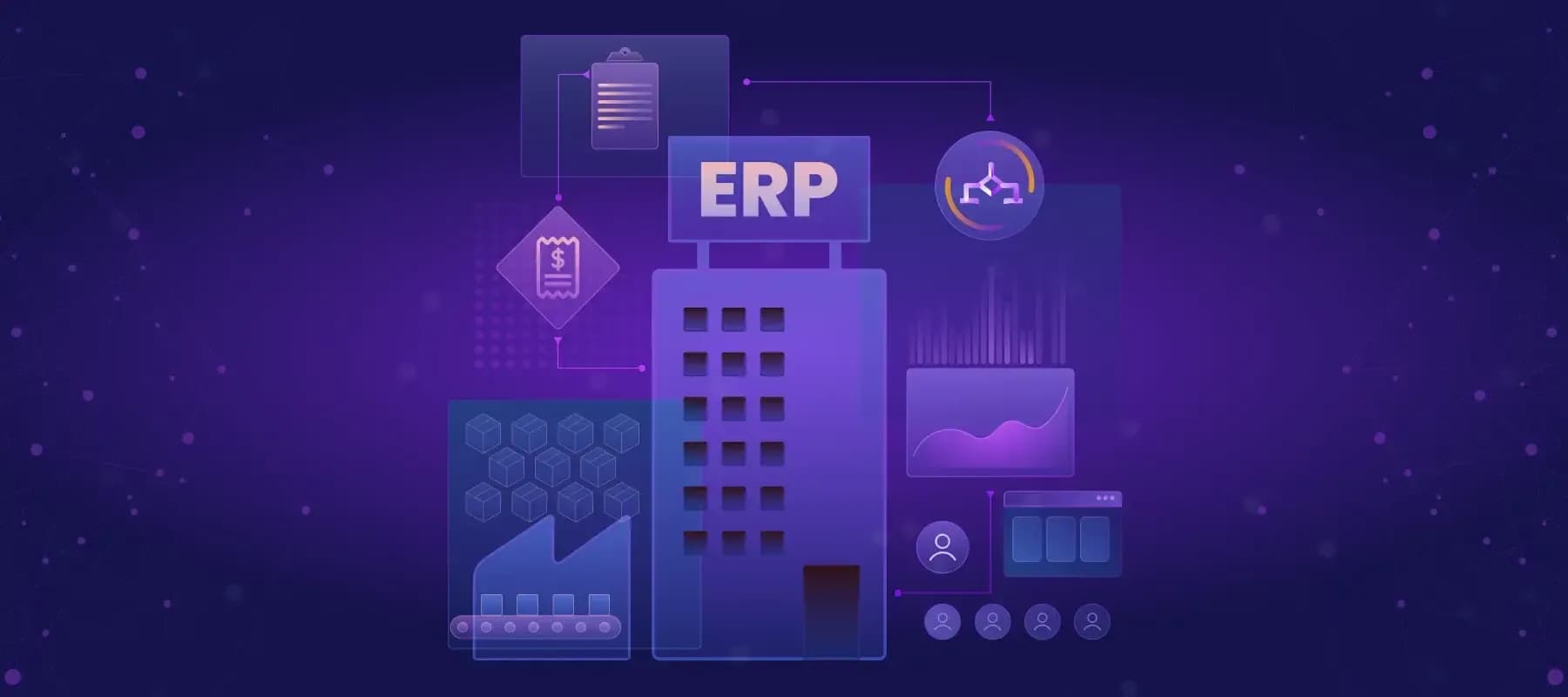
ERP (Enterprise Resource Planning) software helps organizations manage core business functions such as HR, finance, manufacturing, supply chain, sales, and procurement through a single, unified system
With the embedding of machine learning, predictive analysis, natural language processing, and intelligent automation directly into ERP platforms. AI enhances these resource planning systems from passive transaction engines to an active player in the modern business.
Instead of waiting for human inputs or any predefined rules, these ERP systems can anticipate outcomes, recommend actions, and automate decisions across core processes.
In this article, we will discuss how AI builds truly intelligent ERP systems by aligning technology with real enterprise workflows.
What Makes an ERP “Intelligent”?
An “intelligent” ERP system combines data, context, and action. Traditional ERPs used to work on predefined rules, where specific inputs trigger fixed responses. However, the intelligent ERP go one step further than the old ones. They analyze historical and real-time data, understand patterns across workflows, and continuously improve how decisions are made.
An ERP becomes intelligent when it has capabilities like embedded machine learning, context-aware automation, predictive and prescriptive insights, natural language interfaces, assistants, and, most importantly, learning across workflows.
It is important to understand that an enterprise business management software is only intelligent if AI is applied where the work actually happens. It could be approving invoices, managing orders, closing books, hiring talent, and responding to exceptions in real-time.
Architecting AI within Modern ERP Systems
Architecting AI within ERP systems does not mean adding isolated artificial intelligence or some surface-level automation. To build an intelligent and modern ERP system, it is important to embed AI in the system’s core architecture. It allows the AI to continuously observe, learn from, and act within the enterprise workflows.
At the core of the ERP’s transactional and workflow layer is where finance and procurement are generally handled. AI connects to this layer through event signals such as invoice mismatches, payment delays, or order fulfillment issues. This allows the intelligence to intervene and tackle the situation in real time rather than through delayed reporting.
Next is the data and the context layer, which makes an ERP a single and unified system by collecting signals from adjacent systems like CRMs and supply chain platforms. Clean and real-time data provides AI with the context needed to understand how decisions in one function affect outcomes across others.
The intelligence layer hosts domain-specific AI models for forecasting, anomaly detection, optimization, and natural language interaction. These models keep learning from the enterprise data and increasingly use generative AI to translate complex signals into clear recommendations that business users can act on.
How AI Enhances Real Enterprise Workflows (Use Case Breakdown)
AI does not only support one function. Whether it is procurement or order management or even finance or HR, AI predicts outcomes, automates routine decisions, and surfaces actionable insights in real time.
Procure-to-Pay Automation
AI ERP systems enhance procure-to-pay workflows by automating invoice matching, flagging exceptions, and predicting supplier delays.
By integrating enterprise management software and other systems, businesses can improve compliance. They can also gain better visibility across the procurement lifecycle. This level of automation is critical for digital transformation in the business. It helps ensure efficient and scalable operations throughout the business.
For a better understanding, think of a mid-size manufacturing company that is using an AI-enabled ERP system to automatically flag potential supplier delays. Resolving these issues long before they impact production allows the company to easily avoid costly stockouts.
Order-to-Cash with AI
AI-powered ERP software solutions improve the order-to-cash cycle. They forecast demand, optimize inventory, and detect credit risks before these issues affect the revenue.
As an example, consider a retail enterprise using AI-powered ERP to forecast high-demand products. The system automatically adjusts the inventory and alerts the finance team to potential credit risks. Using the best ERP systems for real-time data analytics, an enterprise can streamline business processes and boost cash flow. At the same time, they enhance customer satisfaction.
Finance & Close Processes
Intelligent ERP tools automate the financial reconciliations, detect anomalies, and provide predictive insights that make the financial close process smooth and fast. Organizations using top-rated finance and operations integration solutions in ERP systems see fewer errors. They also gain higher operational efficiency.
Take a global company struggling with a 12-day month-end close. With AI-driven ERP automating financial reconciliations, the cycle can close in just 5 days. It ensures finance teams can focus on strategic decision-making rather than spending hours on manual reconciliation tasks.
HR Workflow Intelligence
Think of a company onboarding 100+ employees each month. AI-enabled ERP systems enhance the HR workflows by supporting candidate screening and shortlisting, automating onboarding, and optimizing workforce allocation.
When using ERP automation for enterprises, HR teams can easily reduce their administrative burden. It also improves the employee experience and can lower labour turnover.
Business Benefits with Metrics
AI-driven ERP systems deliver a measurable business impact that goes far beyond surface-level automation.
According to a report published in January 2025, a study of 300 enterprises examined the impact of AI-enabled ERP systems. The findings showed a 27% fall in processing times, while the accuracy improvements were approximately 35%. These improvements translate into stronger operational performance and fewer manual errors.
In a 2024 Gartner survey, 65% of the CFO’s said that “real-time reporting and forecasting” is their top priority. AI-driven ERP systems support this need by providing real-time analytics, anomaly detection, and prescriptive actions. Companies that are using AI-driven ERP systems have also reported 20%-30% faster decision-making cycles.
These outcomes show that ERP software with embedded AI does more than streamline tasks. It delivers measurable improvements across core business operations.
Implementation Challenges in AI-Enabled ERP Systems
AI-driven ERP systems deliver clear value. However, they also have some implementation challenges around data quality, user adoption, and skill gaps.
- Data Quality & Integration
AI relies on clean and unified data. When the data is inconsistent or siloed from systems, it can lead to errors or incorrect results. Over time, these issues can directly impact revenue.
- Change Management & User Adoption
Without targeted training and communication, employees may avoid using AI-enabled workflows. This directly reduces the effectiveness of ERP automation.
- Skills Gap and Resource Constraints
Many organizations lack in-house expertise in both AI and ERP systems. This skills gap can slow down implementation and limit internal support for teams and leadership.
Best Practices in AI-Enabled ERP Systems
To get the most value from AI-driven ERP systems, organizations need a clear implementation approach. The following best practices help ensure a smoother rollout and better long-term results.
- Plan Data Governance and Integration
It is best to ensure beforehand that the data is clean and unified from all the systems before AI deployment. It allows AI to get clean data to work with and helps AI models deliver reliable results.
- Drive Change Management and User Adoption
Clear communication and leadership are highly important during the ERP implementation. They help employees understand the change and adopt AI-enabled workflows more confidently.
- Address Skills Gaps and Resource Constraints
Phased rollouts, pilot projects and vendor support help manage complexity and reduce risk. Vendor support can also fill skills gaps while internal teams build expertise.
Future Trends in Intelligent ERP
The future of modern ERP systems is being shaped by deeper AI integration, real-time analytics, and scalable cloud deployments. It enables organizations to work faster and make smarter decisions.
Alexander Eser, in a report published on 30th May 2025, has stated that 80% of the ERP vendors are planning to expand their AI functionalities in the next 12 months. This shows their dedication to driving digital transformation into their businesses and the success and growth of ERP in the coming years.
A good share of AI-enabled ERP systems now provide real-time analytics that support operational responsiveness. It moves beyond conventional reporting and supports proactive decision-making.
This change reflects the growing need for automated forecasting, anomaly detection, and scenario planning. It allows business leaders to anticipate any disruptions and adjust the strategies across the relevant departments so the downtime is reduced.
Cloud-based ERP solutions are also rapidly growing, as Jorge Mortenaz stated in his research that almost 60% of the ERP market in 2025 was covered by cloud-based ERP solutions. It is a clear 40% increase since 2020. He also mentioned that this market is expected to grow from $50.57 billion in 2023 to $123.41 billion by 2032. It exhibits a CAGR of 10.4% during the forecast period.
Conclusion
The modern ERP systems utilizing AI are changing the way businesses handle their operations. It includes finance and human resources, as well as procurement and production.
These systems allow intelligence to be integrated into such systems to get real-time insights and enable proactive decision-making. Businesses that implement enterprise resource planning software with AI enjoy efficiency, fewer errors, and greater scalability. It is highly beneficial for greater business-wide digital transformation.
With the ever-changing nature of cloud implementations, real-time analytics, and AI-driven automation, ERP software solutions provide enterprises with flexibility and readiness. Companies that are working with experienced and well-reputed partners like Strateger AI, where AI work actually happens, inside transactions and invoices. This ensures that ERP is bringing measurable business impact rather than theoretical value.
LET'S GET IN TOUCH
Discover How AI-Driven ERP Systems Can Transform Your Enterprise Workflows Today!